Sunday, February 19, 2012

Running through the winter

 This is my first winter where I have run significant amounts, and this is mostly due to training for the Little Su 50k which took place just yesterday.  However, I feel the need to note that I picked one heck of a winter to race a winter ultra!  But more on that later, first, some thoughts on running in the winter.

 With the emergence of the young Spaniard, Killian Jornet, the talk with many ultra runners right now is what to do during the winter "off season" (in quotes because the actual off season varies greatly).  Most runners take as little as a few weeks or as many as a few months off from running at the end of their perspective seasons, and for those of us in North America this also happens to fall around the winter months.  There are much fewer races in the winter, so even training hard through the winter doesn't always make much sense as significant rest can be much more beneficial.  However, Killian competes in ski competitions every winter, and with that hangs up his running shoes until the spring.  While no one can determine the exact reason, he manages to compete in winter ski events and then transition to summer running and compete there as well.  In fact, his early competitions were all skiing, with significant amounts of running coming in just the past few years.

 Many runners are now considering taking on a similar training cycle.  Rather than rest or reduced mileage in the winter they are putting on a fresh coat of wax on the skis and hitting the trail.  Whether or not this will make a difference to those in the front of the pack will be hard to measure, and even then many will debate the true reason.  However, even with my limited knowledge of the human body I can say that often times routine workouts can cause the body to plateau, and simply changing the type of workout, distance, effort, or some other variable can help break out of that rut.  So maybe the changing of skiing to running and back to skiing for many years does a body good.

 Now, back to winter running.  Hitting the trails in the height of winter to most people in the lower 48 probably just means a little more mud, ice, and the occasional cold temperature with a few days of snow, not so in Alaska.  The biggest aspect of winter up here is that the snow is on the ground for a solid 4 months (at least), usually the first snowfall to stick is in November and the snow is on the ground in significant amounts until early April, and this is just in the city, so you must be well aware and mentally ready to run on snow for months.  Many of the mountain trails don't ever fully clear of snow, much like high elevations in Utah or Colorado, with the trails not even becoming runable until at least May.  Even in the summer snow can fall above 3,000 ft and mud, snow fields, and glacier streams are normal on many trails.  Cold years can be much worse.  The first year I can Crow Pass there was still 4-5 feet of snowpack going over the pass, and that was the 3rd weekend in July.

 So running in Alaska in the winter is much different than running in the lower 48 in the winter, case in point this year.  The normal annual snowfall for Anchorage is about 70 inches, we hit that the first week of December.  Already we have had over 100 inches of snowfall, and we still have 2 months left and with that at least 2 more storms of 6 inches or more.  Our year to date totals have been past the record year of 54-55 where 132 inches of snow fell.  I don't think we are going to break that record, but there is a lot of snow out there!  Also, January was one of the coldest months on record as measured by average temperature, which I believe ended up somewhere around 2 degrees, brrr.

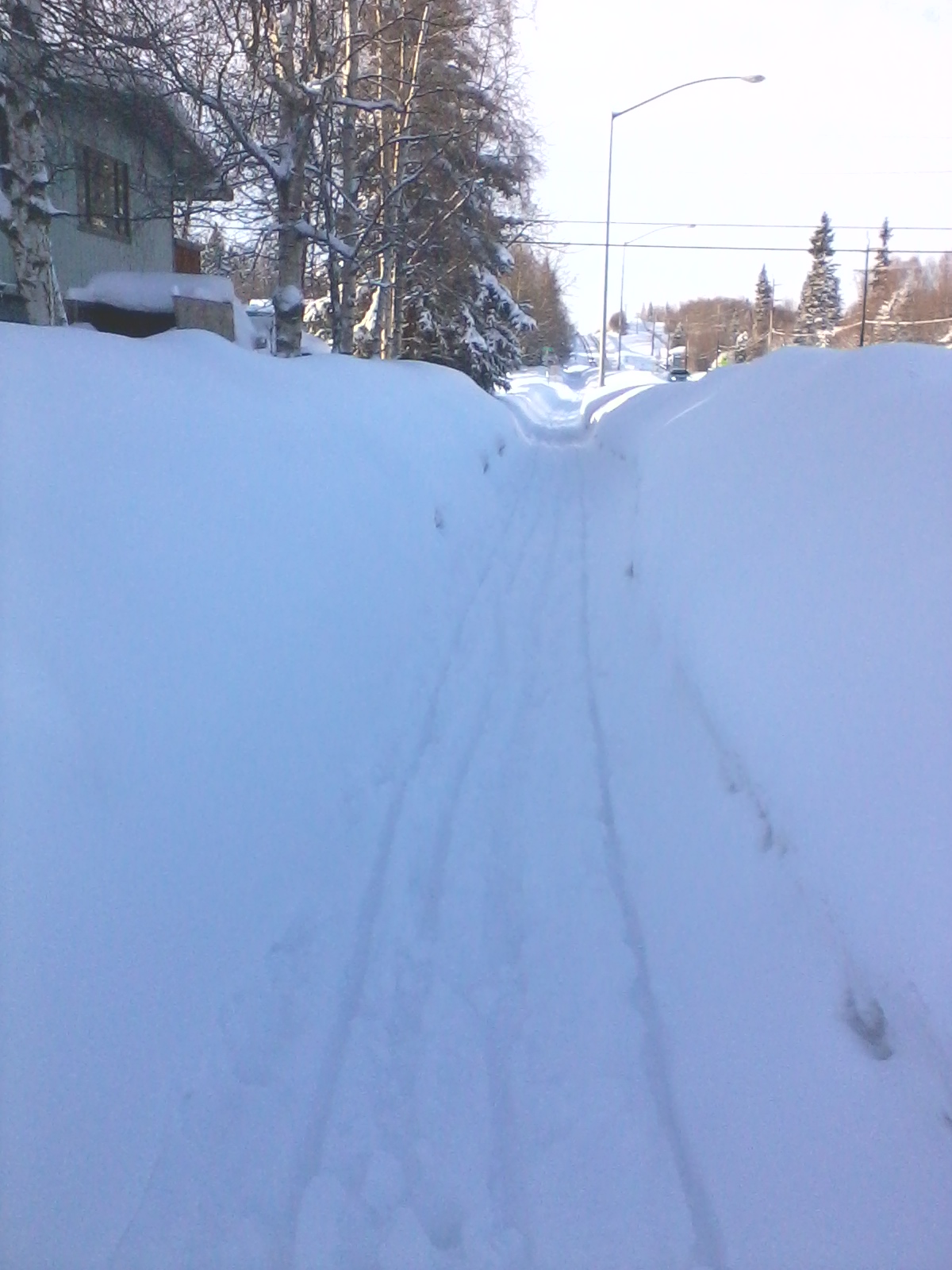
 The long and short of it, I picked one heck of a winter to run an ultra!  And my rookie ultra at that!  That 24 miler at -5 degrees was pretty darn tough, and the 16 miler as my last long run in 8 inches of fresh snow was also tough!  But I will dive more into that in my post race review.  Essentially, I just wanted to go over some winter thoughts and also post some pictures I took of my last run before the race, they don't really give justice to the amount of snow but do give you an idea of the current snow pack.
I should get my post race report up later this week, for now, enjoy some snowy pictures!

Running through 8 inches of fresh, unbroken powder. 

Trail breaking in the fresh snow is actually pretty fun!

A consequence of running along the road.  The snowplows come through and throw hard and packed snow on the trail, impossible to run as you have to conduct shin deep post holing. 

Many sidewalks have become tunnels around town, these walls about 5 feet high.


This trash can helps put the snow pack into perspective as it is now barely sticking out from the snow. 

There is actually a bench under there. 

The bench.  This section of the trail is susceptible to snow drifts so it usually has greater snowpack.

This isn't a really tall sign, about 3 feet or so, but gives you an idea of the snowpack on the local groomed trail.

Sunday, January 29, 2012

Little Su 50k gear check

This weekend was my last long training run (24 miles) before the Little Su 50k which is now just 3 weeks away, so I thought it would fitting to do a gear check.  It is not uncommon for an ultra marathon to have some sort of gear requirement, and a winter race in Alaska is no exception, even if it is only 50k (and none of the gear has anything to do with the cold).  Also, like a few other Alaska distance races, this race is almost entirely self supported, so having sufficient gear and safety items for being alone for hours in the cold is important.

With that said, here is a list of the required gear plus the few additional items I plan on bringing with me.

Required Items


2 quart insulated water container - I got a new Salomon pack for Christmas that I plan on using.  While it is not insulated, I have insulated the tube and the bladder rests against my back so I figure my body heat keeps the bladder from freezing.  I ran 24 miles yesterday in 4 1/2 hours at -5 degrees and it didn't freeze, so this set up will work just fine.  I shove the valve inside my vest so it rests against my body and then blow the water back into the bladder to keep the line clear, so far this has proven effective.  There is an aid station at the halfway point with water, so if I top off with water there then 2 quarts plenty of capacity.

Headlamp or flashlight - I have a Pelican headlamp that I have used for a few years now for running in the dark.  While it only has 9 lumens on high mode, it is a 3 LED setup so the battery life is really good.  I wouldn't use this for a 100 miler in the summer due to the low light output, it provides sufficient light for use in the winter due to snow reflection.  I only plan on being the dark, if at all, for a short period of time, so this light will be sufficient.

Rear flashing light - I have a small red blinking light that I have clipped to the back of my headlamp strap, but since most of the race is on snow machine trails and this is a high snow year in Alaska, I plan on also using the larger blinker I have on my bike so I don't get squished by any snowmachines.

Additional Items I Will Carry


Wind Gear - Where the race takes place is prone to high winds, with that said I also now have a nice Brooks running jacket (5 oz) and a pair of Mont Bell ulra light pants (3 oz) that I will have in my pack should high winds occur, and they are light and small enough they are not even noticeable.

First Aid Kit - I bought a small, personal first kit at REI, mostly due to running distances in the winter and wanting to be prepared since I am out on my own for hours.  I have added a heat blanket and strike anywhere matches, and this is also where I keep extra batteries for my headlamp.

Hand Warmers - Two of my long runs, including yesterday, I have had to break out the hand warmers.  They last 2-4 hours so depending on the temperature I may actually schedule using them into my race day plan.  These are very light so I will probably carry 4-8 in my pack, enough for my hands and feet for up to 8 hours if needed.

Clothing - Racing in sub freezing weather means your head gear freezes up for various reasons and then becomes rather uncomfortable, and since there are no drop bags allowed, any gear changes mean I will have to have the items on hand.  Unless the weather is warm, I will plan on bringing a change of head gear with me, the exact combination I won't determine until I know the race day weather forecast.

Fuel - Lately my fuel of choice is Powerbar Gels, I started using these because they are thinner and don't get super thick when they freeze like Gu or other similar products, and luckily the taste has been pretty good too.  I will probably carry about 8 of these and a Stinger Waffle as well.

I will go over my race day plans in a few weeks when the race is closer, but wanted to cover gear now as I have it pretty well dialed in.  Part of training for ultras is simulating race day conditions on long runs, so for me that means carrying the above gear and running in the same temperature, which is important as this is a winter race. Although training on long runs has been mentally challenging if more than anything as we are having both the snowiest winter and coldest January on record here in Anchorage.  Overall though the training is going well, other than some achiles pain, but I should be able to make it 31 miles regardless.

As the 2 Gomers would say, Happy Running!